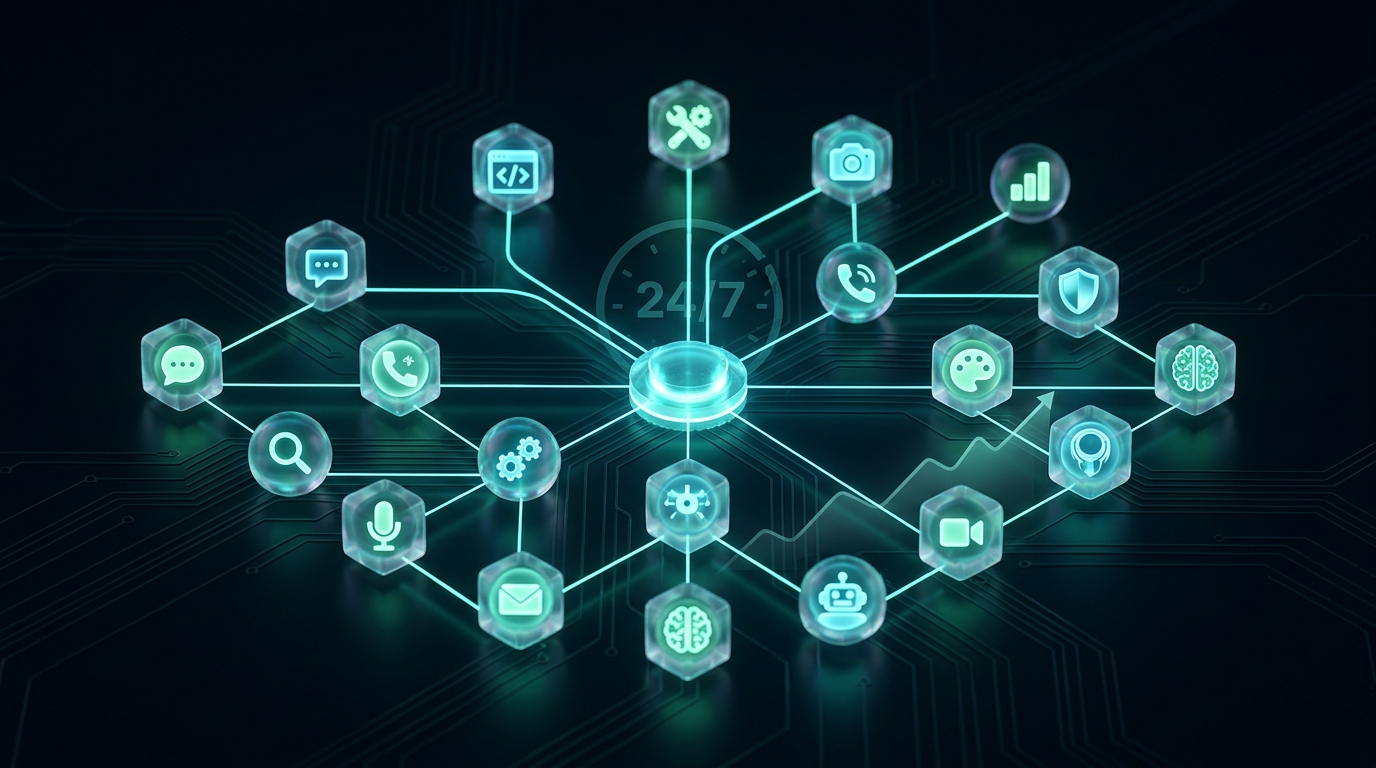
A multi-agent AI system is a team of specialized AI agents — each
with its own role, tools, and context — coordinated by an orchestrator
toward shared goals. A single chatbot answers; a multi-agent system does
work. This isn’t theory here: NMA IT operates a 15-agent system every
day, and this playbook shows exactly what it does.
What Is a Multi-Agent AI
System?
A multi-agent AI system is several AI agents working together on
shared goals, with an orchestrator deciding who does what. Each agent is
an AI program that plans, uses tools (search, APIs, databases, files),
and acts — not just chats. Agents specialize: one researches, one
writes, one publishes, one measures.
The difference from a single AI assistant is structure. A chatbot is
one brain with one context window; a multi-agent system is a department
— separate workers, separate tools, separate outputs, clear handoffs.
IBM describes multi-agent systems as “multiple AI
agents working collectively” on tasks too complex for one agent.
This is production infrastructure now, not a research concept.
Gartner projects that 40% of enterprise applications will incorporate
task-specific AI agents by the end of 2026, up from less than 5% in 2025
— and that over 40% of agentic AI projects will be canceled by the end
of 2027, mostly over cost, unclear value, and weak risk controls. We run
one of these systems; that gap between adoption and failure is why we’re
publishing how ours works.
Why One Giant Chatbot Isn’t a
Team
Single-agent setups hit three walls in production:
Context. One agent carries one context window. Give
it lead generation, sales, WordPress, and content, and it forgets the
start of its own day. Specialists carry only the context their job
needs.
Tool sprawl. A business agent needs many tools:
Apollo, Google Maps, a leads database, Discord webhooks, SMTP,
WordPress, YouTube’s API. Wired into one agent, every task drags every
tool along; split by function, each agent stays simple.
No specialization. Quality comes from focus. The
model that writes a sharp LinkedIn post is not the one triaging a leads
database or publishing to production. Separate agents let you pick the
right model per job and swap one without touching the rest.
The fix for all three is the pattern you see in serious agentic AI
deployments: orchestrator plus specialists. Google’s AI agent
explainer describes agents built to collaborate on complex workflows
— which is exactly what we run, self-hosted, on OpenClaw, an open-source
agent framework.
The NMA IT System: 15
Agents, One Operation
We run fifteen agents on a single OpenClaw gateway, sharing one
server and one workspace; each keeps its own identity, memory, and
output folders. Most names are Bengali job words — Kendro means
“center,” Netra “vision” — so a Discord channel list reads like an org
chart.
The Roster, Role by Role
| Function | Agents | What they do |
|---|---|---|
| Command | NMA (main coordinator), Kendro (orchestrator) | Goals, dispatch, oversight |
| Lead generation | Shondhan | Daily prospect hunt, scoring |
| Sales | Bikkhoy | Takes qualified leads, drives outreach |
| Marketing | Biponon | Marketing content and campaigns |
| QA | Parikshak | Tests builds and agent output |
| WordPress | WpBuddy | Runs nma-it.com: builds, publishing, backups |
| Mobile | SwiftDroid (iOS); Droid, MCDroid, KajDroid (Android) | Client app projects |
| Backend | Nirman, Sonthok | APIs, servers, pipelines |
| Content | Kodom (research) → Lekhok (LinkedIn), Prakash (metadata), Uron (publish), Yontro (video), Netra + Netro (analytics) |
Research-to-published content chains |
Several roles carry multiple named agents — per-project mobile
agents, paired backend agents, a five-step content chain (Kodom → Lekhok
→ Prakash → Uron → Netra and Netro) — because the work runs in
parallel.
One
Gateway, One Workspace — and Why Models Differ Per Agent
One gateway means one place for logs, one routing map, one security
boundary, one backup. Agents hand off through the shared workspace: each
writes output to its own directory, the next picks it up.
Model choice is per agent, a cost/quality decision. Our default
reasoning model is DeepSeek: strong quality at a fraction of the price
of the big proprietary models. Some agents open with a cheaper or
free-tier model and escalate only when the first pass misses. That
fallback chain is why a pipeline touching several agents can still cost
fractions of a cent per run.
Discord Is the Office
The human interface is Discord. Every function has channels:
#sales-general for sales handoffs, #lead-sourcing for the hunt,
#mkt-general for marketing, plus the content chain’s #content-lab,
#studio, #launchpad, and #dashboard. Agents post output to their channel
before every handoff, so the operation stays visible — nobody reads
logs, they scroll a channel. That visibility makes fifteen autonomous
agents manageable instead of terrifying.
What It Actually Does Every
Day
The Daily Lead Hunt
Every morning at 03:00 UTC, Shondhan runs the hunt: fresh prospects
from Apollo and Google Maps, enrichment, email verification, and a
fit-and-intent score for each. Qualified leads go into the leads
database and appear as cards in #sales-general, owned by Bikkhoy. The
pipeline has tracked nearly 300 prospects and currently holds more than
100 qualified leads. Shondhan self-corrects, too — on early runs it
cleaned bad enrichments and flagged Apollo duplicates.
The Inbound Contact Pipeline
A contact-form submission on nma-it.com hits a webhook server, is
dedupe-checked, and lands in the leads database. A ping posts to
#sales-general so sales picks it up immediately, and an email goes out
via Brevo SMTP. The webhook answers HTTP 204 — a clean, empty
acknowledgment — so the form never hangs. Every step is logged; the
dedupe check is verified, so the same person cannot enter twice.
Content, Publishing, and
Housekeeping
The content chain produces real output end to end: Kodom’s research
becomes LinkedIn posts (Lekhok), finished videos (Yontro), scheduled
publishing (Uron), and analytics (Netra, Netro). The run that proved the
pipeline published three full videos in a single day with zero human
intervention. Scheduled jobs handle the unglamorous work: backups,
research briefs, funnel reports, monitoring. This post moved through the
same chain.
What It Costs to Run
Less than people assume — and the biggest cost isn’t the APIs.
Model APIs. Most agents default to DeepSeek, which
is cheap by design; several try free or low-cost models first and
escalate on misses. Our documented video pipeline runs at roughly $0.002
per video in inference.
Infrastructure. The whole gateway runs on one
self-hosted Linux VPS — no GPU — documented at $10–20 per month.
Tools. Apollo credits, Brevo SMTP, YouTube’s API,
Discord. Pay-as-you-go, mostly small.
Human review. The largest line item, and deliberate.
Agents draft; Leo reviews posts and campaigns before they ship. That
review time is the quality gate that keeps agent output from becoming a
liability.
Your costs will track the same shape: small hosting, small inference,
and a deliberate human review budget sized to how much you let agents
touch before a person looks.
When It Breaks: A
Real Failure Post-Mortem
Agents fail. If a vendor tells you otherwise, they haven’t run one in
production. On September 3, 2026, Shompod — an agent on the content side
— went silent. No output, no error; just nothing.
Diagnosis took minutes. Gateway logs showed Shompod had stopped
answering entirely. Root cause: a missing route binding — the routing
map that decides which agent answers which channel had lost Shompod’s
entry. The model, prompt, and server were fine; the agent simply wasn’t
reachable. Fix: one line in the binding config, then a gateway restart.
Output resumed normally.
That incident is the best argument for the architecture above: agents
post to visible channels, so silence is noticeable; one gateway makes
logs greppable; explicit routing config makes a failure findable and
fixable in minutes — not a mystery inside one of fifteen black
boxes.
The other kind of breakage is security. Across August and September
2026 we ran a full malware sweep on the WordPress server behind
nma-it.com, coordinated between agents on the gateway: multiple
backdoors quarantined, core restored and checksum-verified, credentials
rotated, and the command-and-control endpoint sinkholed. That happened
because the system is monitored — not because AI is magic.
Could Your
Business Run a Multi-Agent System?
Realistic answer: maybe — and probably smaller than this.
Start with the workflow, not the technology. You want multiple agents
when work is recurring, multi-step, crosses several tools, and has
natural handoffs: leads flowing to sales, research flowing to content,
tickets flowing to QA. You want a single agent when one person-shaped
job covers it. You want humans when judgment, money, or reputation rides
on every output. Most failed agentic AI projects fail from ambition, not
capability — running one agent well is a win.
Need a team? You need an orchestrator — the layer that routes work,
holds shared state, and decides which agent answers which channel.
Kendro and the main coordinator NMA play that role; the routing map they
use is exactly what broke in September. Orchestration is the discipline
part of agentic AI — without it, fifteen chatbots, not a team.
The market moves this way whether you build or buy — Gartner expects
40% of enterprise applications to ship task-specific AI agents by end of
2026, yet projects over 40% of agentic AI projects canceled by end of
2027. The difference is operations, not models. Evaluating vendors
instead? Our guide
to the top AI automation service providers in the USA is a good
starting point.
FAQ
What is the difference between an AI agent and a multi-agent
system? An AI agent is one program that plans and performs
tasks with tools like search, APIs, and databases. A multi-agent system
is several such programs working together — each specialized,
coordinated by an orchestrator. One employee versus a department: the
agent handles a job end to end; the system divides work and hands it
between specialists.
What can small businesses automate with AI agents?
Lead sourcing and scoring, answering inbound inquiries, drafting and
publishing content, reports, backups, monitoring — all realistic today.
NMA IT runs each daily: a morning lead hunt, an inbound pipeline for
contact-form submissions, a content chain that publishes posts and
videos. Start with one recurring workflow that crosses a couple of
tools; that is where agents pay for themselves fastest.
Do you need to be technical to run AI agents? One
simple single-purpose agent needs basic scripting and configuration
skills. Fifteen agents with custom integrations, logs, routing, and
security needs real technical skill. Non-technical owners should start
with a managed service or hire someone to operate the system —
operations are where agent systems succeed or fail.
How much do AI agents cost? It depends on models,
workload, and agent count. Ours runs on one self-hosted server
documented at $10–20 per month; inference stays low-cost because we
default to DeepSeek and use free tiers where quality allows — our
documented video pipeline costs about $0.002 per video. The biggest cost
is usually human review time; budget for it on purpose. A small business
starting with one or two agents should expect hosting plus modest API
usage — far less than a headcount.
Are multi-agent systems reliable? Yes — for daily
production work, when treated as systems: visible channels, logs,
explicit routing, humans in the loop. Agents can fail silently; one of
ours stopped answering entirely on September 3, 2026, until we fixed a
missing route binding. Reliability comes from monitoring and operations,
not the models.
What is agent orchestration? Agent orchestration is
the layer that decides which agent handles which task, in what order,
and how results pass between them — a dispatcher for AI workers. It
tracks shared state, routes messages to the right specialist, and
manages handoffs. Without it, agents are isolated tools; with it, a
team.
Get a Multi-Agent System
Like This
We build and operate systems like this one — self-hosted on OpenClaw,
sized to the workflow, visible in Discord, humans in the loop — and the
quieter version: one agent automating one painful workflow before you
scale to a team. If you want the same for your business, talk to us.
Watch the video
Prefer reading? The full written breakdown is above — the video covers the same system in 27 seconds.